Our Thesis
Bridging the ASEAN–GBA Information Gap: DMN as Market Intelligence Infrastructure
Market Context: ASEAN–GBA Growth and the Information Gap
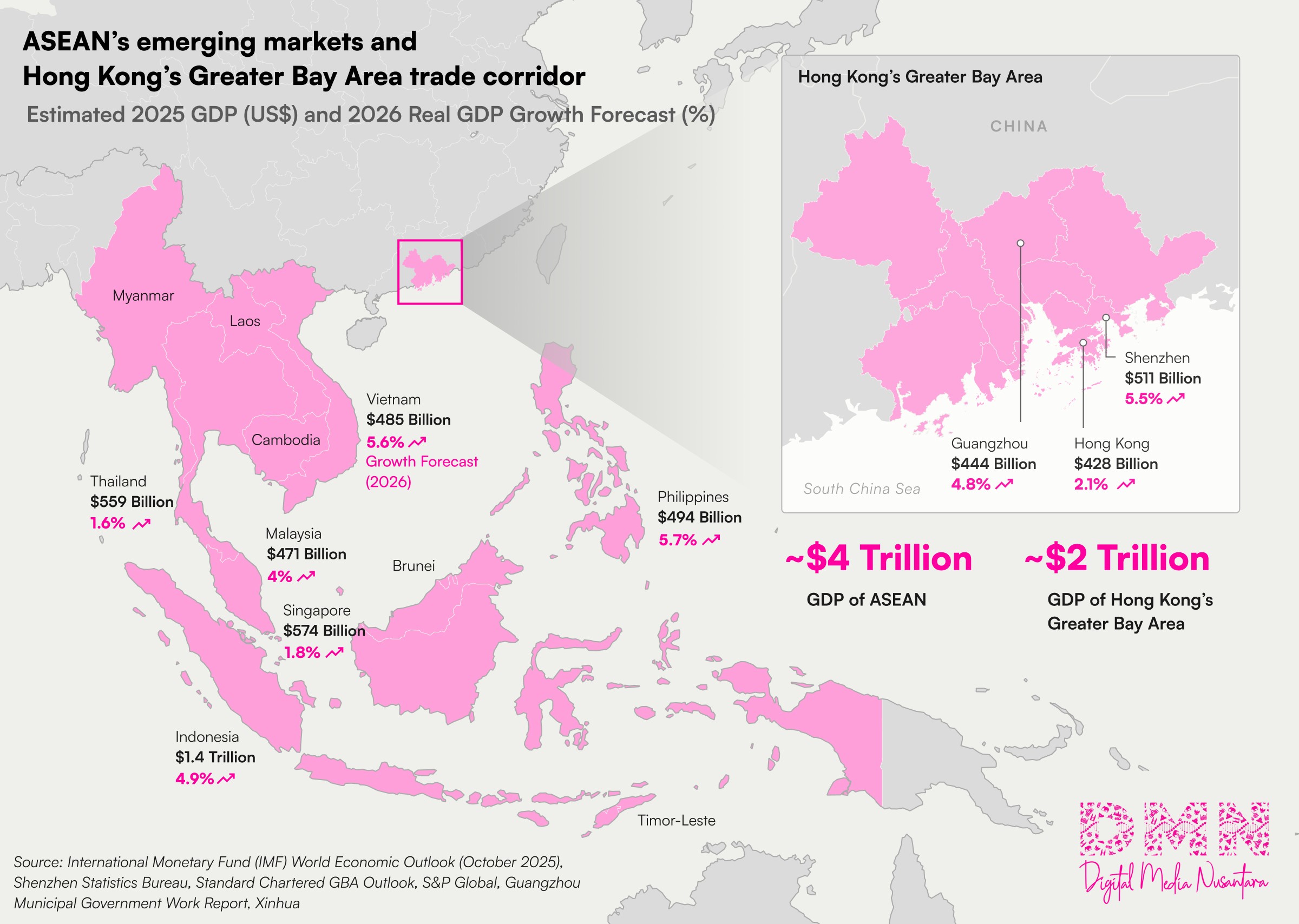
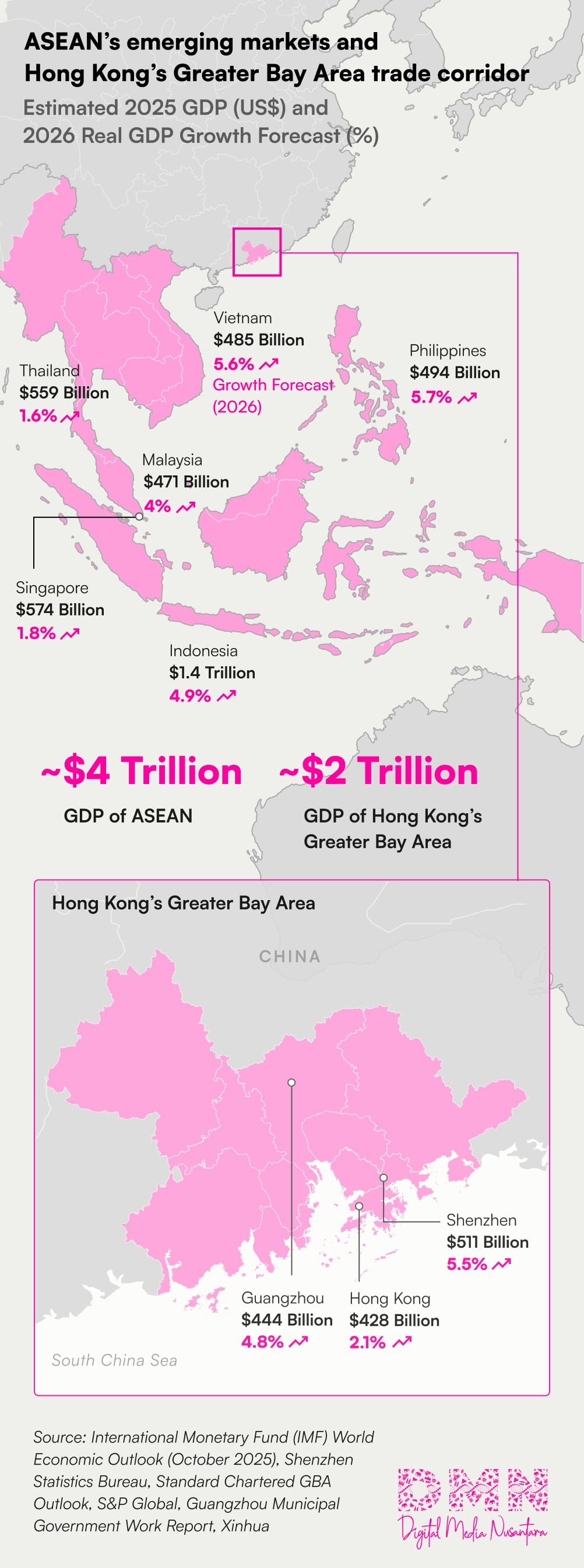
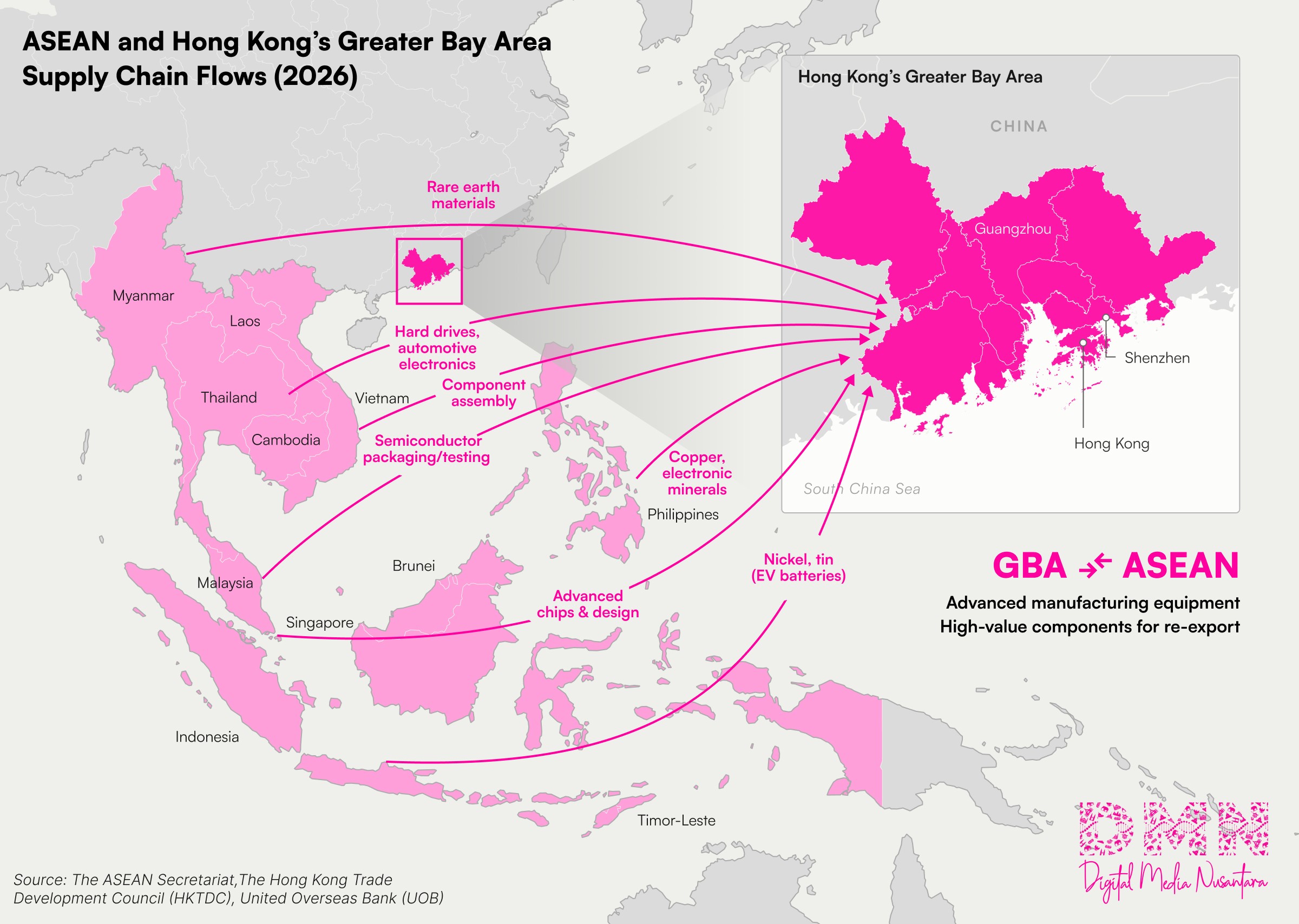
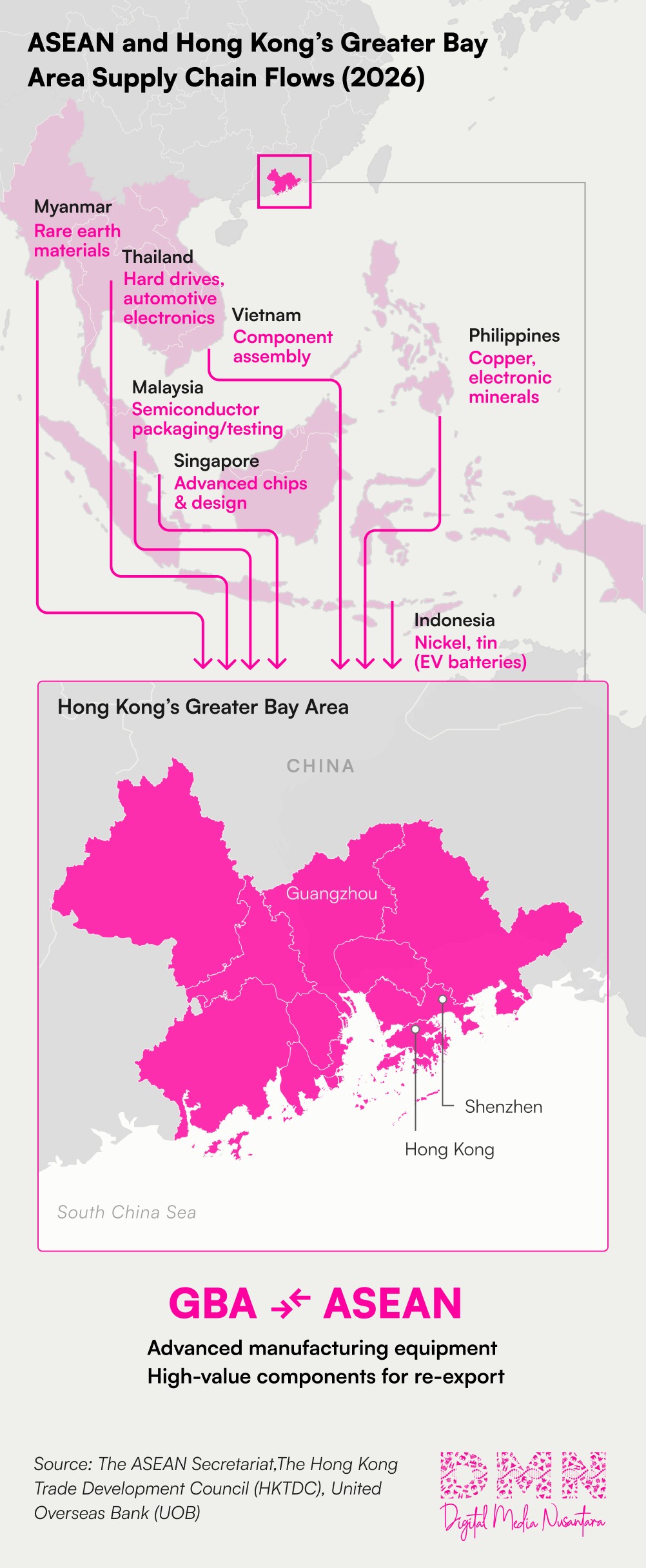
The ASEAN–Greater Bay Area (GBA) corridor links one of the world’s largest emerging markets with a leading Chinese economic hub. ASEAN now constitutes a USD3.9 trillion economy with 678 million people, while China’s GBA (11 cities including Hong Kong and Shenzhen) adds 86 million people in a top-tier finance and technology cluster.
Trade between ASEAN and China reached nearly USD1 trillion in 2024, making ASEAN China’s largest trading partner. Investment flows are rising in tandem: ASEAN captures ~14.5% of global FDI, and China’s share of new foreign investment in key ASEAN countries has jumped from ~10% to over 25% in the past decade.
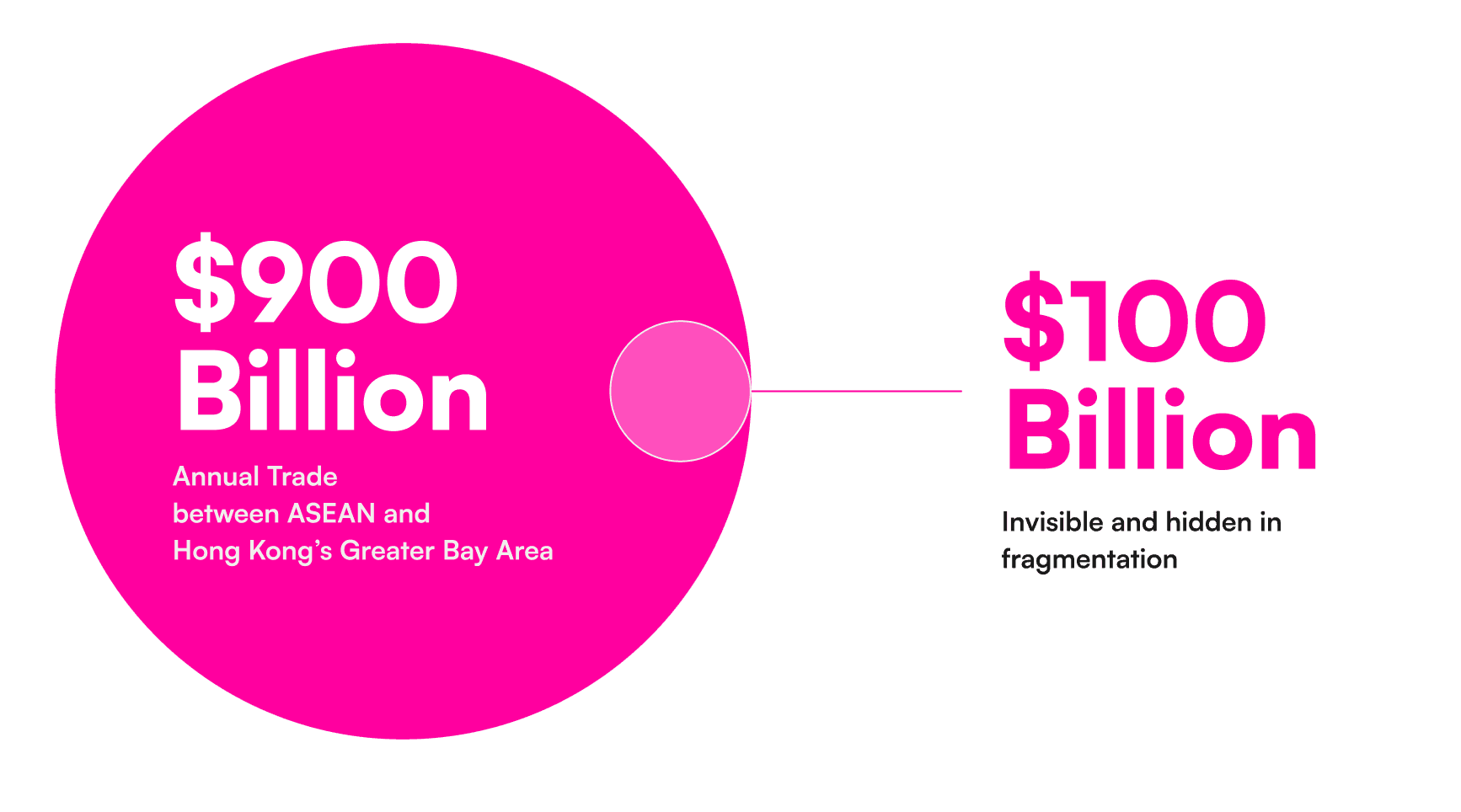
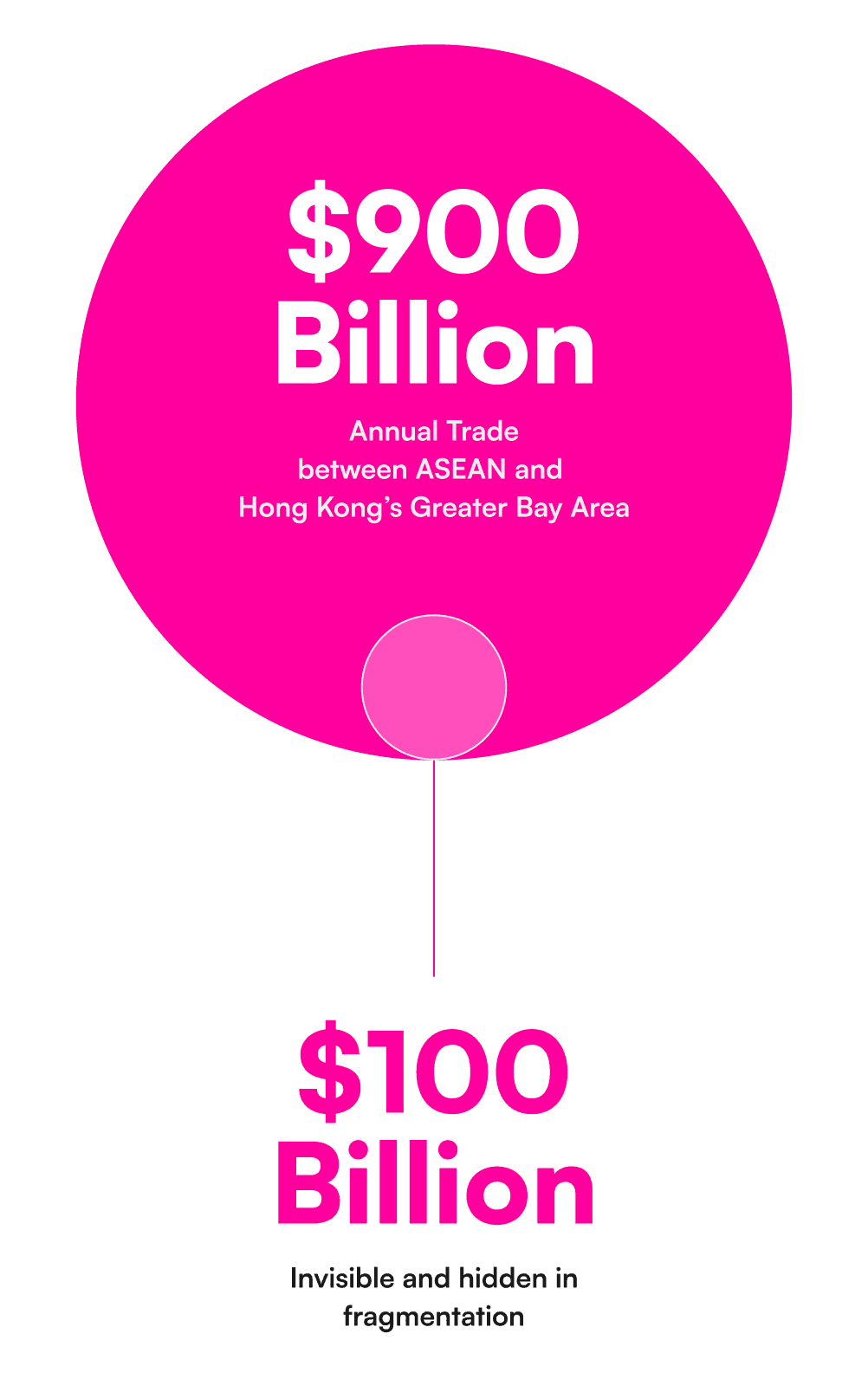
Paradoxically, this booming corridor suffers a structural information deficit. Despite deepening ties, over USD100 billion of ASEAN–GBA trade flows remain “mispriced or unmapped”, unseen in any single data system. No bank, government, or institution has a complete view of these cross-border transactions, tariffs, and supply chain exposures.
This information asymmetry means value moves “invisibly” through fragmented trade flows and opaque supply chains. When vital economic data is hidden, markets cannot price assets or allocate capital optimally. This blind spot misprices risk and opportunity at every layer of the economy. Governments may mistarget incentives, banks miss lending opportunities, insurers misprice premiums, and manufacturers pick suboptimal suppliers in the absence of reliable intelligence.
Market Context: ASEAN–GBA Growth and the Information Gap
The ASEAN–Greater Bay Area (GBA) corridor links one of the world’s largest emerging markets with a leading Chinese economic hub. ASEAN now constitutes a USD3.9 trillion economy with 678 million people, while China’s GBA (11 cities including Hong Kong and Shenzhen) adds 86 million people in a top-tier finance and technology cluster.
Trade between ASEAN and China reached nearly USD1 trillion in 2024, making ASEAN China’s largest trading partner. Investment flows are rising in tandem: ASEAN captures ~14.5% of global FDI, and China’s share of new foreign investment in key ASEAN countries has jumped from ~10% to over 25% in the past decade.
Paradoxically, this booming corridor suffers a structural information deficit. Despite deepening ties, over USD100 billion of ASEAN–GBA trade flows remain “mispriced or unmapped”, unseen in any single data system. No bank, government, or institution has a complete view of these cross-border transactions, tariffs, and supply chain exposures.
This information asymmetry means value moves “invisibly” through fragmented trade flows and opaque supply chains. When vital economic data is hidden, markets cannot price assets or allocate capital optimally. This blind spot misprices risk and opportunity at every layer of the economy. Governments may mistarget incentives, banks miss lending opportunities, insurers misprice premiums, and manufacturers pick suboptimal suppliers in the absence of reliable intelligence.
Information Asymmetry and Market Inefficiency
In economic theory, information asymmetry occurs when some market participants have better information than others, often leading to mispricings and market failures. The ASEAN–GBA corridor epitomises this: data is siloed across countries and industries, leaving each actor seeing only a fragment of the whole. Such gaps violate the core assumption of the Efficient Market Hypothesis (EMH) that all available information is reflected in prices.
EMH posits that in fully transparent markets, consistent excess returns are unattainable. But here, critical trade and capital flow information is not fully available, creating persistent inefficiencies. Legendary quant investor Jim Simons, founder of the Medallion Fund built his strategy on the belief that markets are not perfectly efficient: “The efficient market hypothesis is not correct. There are a lot of inefficiencies in the market, and with enough data and enough computing power, they can be uncovered.”
The Medallion fund’s success demonstrates that even in major markets, complex hidden inefficiencies exist, often “hidden in the markets in code” awaiting decryption by those with superior information and analytics. This worldview suggests that in emerging or opaque regions like ASEAN–GBA, underexploited informational edges are especially prevalent. Fragmented data and low transparency mean asset prices and investment flows do not fully reflect fundamentals.
Savvy investors recognise this as an opportunity. In other words, the corridor’s inefficiencies, born of information asymmetry, represent untapped alpha for those equipped to gather and process the missing information. Absent corrective measures, these mispricings also hinder efficient capital allocation and growth in the region.
Information Asymmetry and Market Inefficiency
In economic theory, information asymmetry occurs when some market participants have better information than others, often leading to mispricings and market failures. The ASEAN–GBA corridor epitomises this: data is siloed across countries and industries, leaving each actor seeing only a fragment of the whole. Such gaps violate the core assumption of the Efficient Market Hypothesis (EMH) that all available information is reflected in prices.
EMH posits that in fully transparent markets, consistent excess returns are unattainable. But here, critical trade and capital flow information is not fully available, creating persistent inefficiencies. Legendary quant investor Jim Simons, founder of the Medallion Fund built his strategy on the belief that markets are not perfectly efficient: “The efficient market hypothesis is not correct. There are a lot of inefficiencies in the market, and with enough data and enough computing power, they can be uncovered.”
The Medallion fund’s success demonstrates that even in major markets, complex hidden inefficiencies exist, often “hidden in the markets in code” awaiting decryption by those with superior information and analytics. This worldview suggests that in emerging or opaque regions like ASEAN–GBA, underexploited informational edges are especially prevalent. Fragmented data and low transparency mean asset prices and investment flows do not fully reflect fundamentals.
Savvy investors recognise this as an opportunity. In other words, the corridor’s inefficiencies, born of information asymmetry, represent untapped alpha for those equipped to gather and process the missing information. Absent corrective measures, these mispricings also hinder efficient capital allocation and growth in the region.
DMN’s Market Intelligence Infrastructure: Enabling Efficient Markets
Digital Media Nusantara (DMN) addresses this structural gap by providing what is essentially the missing infrastructure for market intelligence in the ASEAN–GBA corridor. DMN is not a media company but a data infrastructure operating at sovereign-grade standards to illuminate the corridor’s hidden economic activity.
Its flagship engine, Rainmarket, “consolidates fragmented market data into unified, actionable intelligence,” solving the fundamental challenge of viewing six diverse ASEAN markets plus the GBA as one coherent opportunity set. In practice, Rainmarket ingests and connects disparate trade, finance, and supply-chain data, using AI-driven analytics to surface patterns and signals invisible to any single stakeholder.
By architecting this intelligence layer, DMN aiming to transform regional trade flows into a transparent, efficient, and accessible frontier for global capital allocation.” The previously unseen USD100 billion in annual flows are now being converted into “investible, financeable, and risk-managed” opportunities. In economic terms, DMN's engine reduces information asymmetry dramatically, bringing the corridor closer to EMH conditions where prices can reflect true supply-demand dynamics.
The strategic value is significant for all stakeholders: Investors gain an institutional-grade view of the ASEAN–GBA market, letting them confidently deploy capital based on real-time trade data and uncover mispriced assets rather than flying blind. Banks and funds can identify under-served financing opportunities and price risk more accurately across borders.
Policymakers and regulators, for the first time, can base decisions on comprehensive corridor intelligence, improving policy targeting and regional coordination. Even corporate and data partners benefit, as their own data (e.g., port statistics, supply chain records) becomes part of a richer mosaic that turns fragmented activities into “actionable signals for capital allocation, risk pricing, and policy decisions.”
By illuminating the ASEAN–GBA (“New Silk Flow”), DMN’s infrastructure helps modernise the market by increasing transparency, trust and liquidity. In essence, DMN provides the informational spine needed to transition this corridor from a collection of opaque emerging market nations, into an integrated efficient market ecosystem. This intelligence infrastructure corrects the structural informational deficit, allowing capital to flow where it is most productive; and thus enabling risk to be managed with the avant-garde finesse and precision.
DMN’s Market Intelligence Infrastructure: Enabling Efficient Markets
Digital Media Nusantara (DMN) addresses this structural gap by providing what is essentially the missing infrastructure for market intelligence in the ASEAN–GBA corridor. DMN is not a media company but a data infrastructure operating at sovereign-grade standards to illuminate the corridor’s hidden economic activity.
Its flagship engine, Rainmarket, “consolidates fragmented market data into unified, actionable intelligence,” solving the fundamental challenge of viewing six diverse ASEAN markets plus the GBA as one coherent opportunity set. In practice, Rainmarket ingests and connects disparate trade, finance, and supply-chain data, using AI-driven analytics to surface patterns and signals invisible to any single stakeholder.
By architecting this intelligence layer, DMN aiming to transform regional trade flows into a transparent, efficient, and accessible frontier for global capital allocation.” The previously unseen USD100 billion in annual flows are now being converted into “investible, financeable, and risk-managed” opportunities. In economic terms, DMN's engine reduces information asymmetry dramatically, bringing the corridor closer to EMH conditions where prices can reflect true supply-demand dynamics.
The strategic value is significant for all stakeholders: Investors gain an institutional-grade view of the ASEAN–GBA market, letting them confidently deploy capital based on real-time trade data and uncover mispriced assets rather than flying blind. Banks and funds can identify under-served financing opportunities and price risk more accurately across borders.
Policymakers and regulators, for the first time, can base decisions on comprehensive corridor intelligence, improving policy targeting and regional coordination. Even corporate and data partners benefit, as their own data (e.g., port statistics, supply chain records) becomes part of a richer mosaic that turns fragmented activities into “actionable signals for capital allocation, risk pricing, and policy decisions.”
By illuminating the ASEAN–GBA (“New Silk Flow”), DMN’s infrastructure helps modernise the market by increasing transparency, trust and liquidity. In essence, DMN provides the informational spine needed to transition this corridor from a collection of opaque emerging market nations, into an integrated efficient market ecosystem. This intelligence infrastructure corrects the structural informational deficit, allowing capital to flow where it is most productive; and thus enabling risk to be managed with the avant-garde finesse and precision.
Envisioned by DMN,
Built for the Financial Markets.
Envisioned by DMN,
Built for the Financial Markets.